
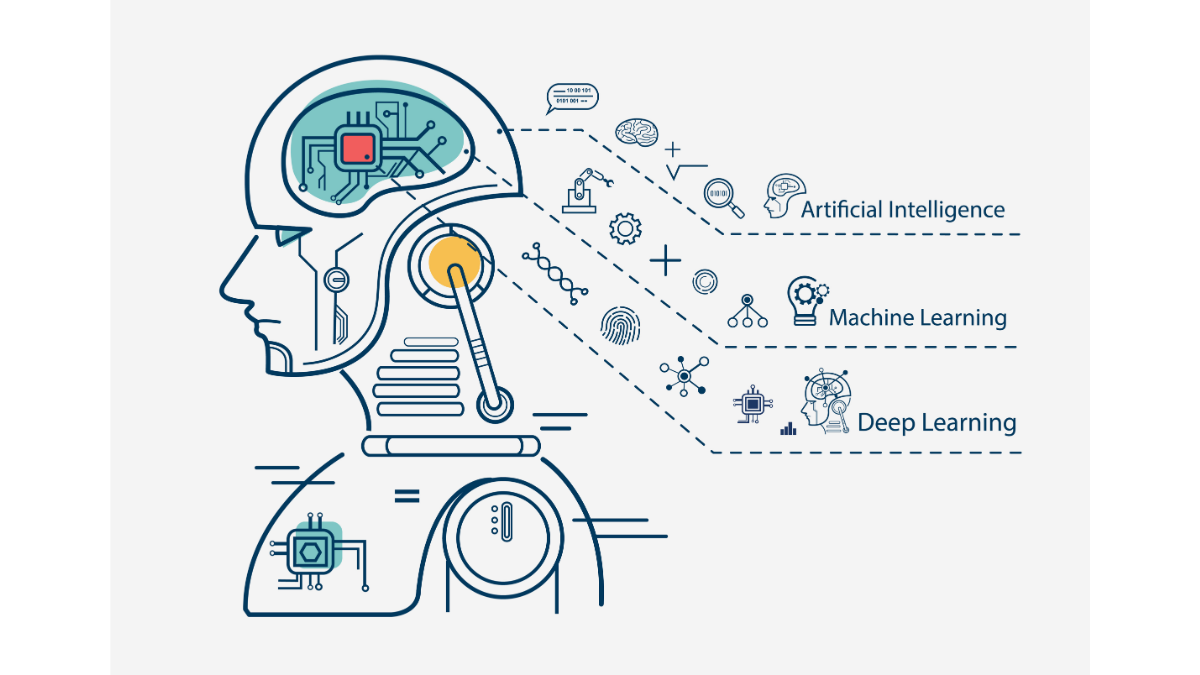

Sundar Pichai, CEO of Alphabet, once remarked, “AI is more profound than electricity or fire.” This comprehensive guide introduces beginners to AI, its sibling ML (machine learning), and its transformative role in reshaping security practices.
Artificial Intelligence (AI) and Machine Learning (ML) have evolved from mere buzzwords to foundational components within the digital landscape. Understanding these technologies is crucial for individuals venturing into the tech industry. To facilitate this understanding, an AI for Beginners guide has been crafted. While AI and ML have existed for some time, their significance has grown exponentially in recent years. This article is a comprehensive introduction to the fundamentals of AI and ML, exploring their potential to revolutionize various aspects of our lives and professional endeavors. Moreover, the discussion will extend to the vital topic of AI security in today’s world.
The Dawn of AI and ML – A Historical Perspective
In 1956 John McCarthy coined ‘Artificial Intelligence’ (AI), sparking an incredible journey. The 1960s saw the flourishing of early AI with dedicated technology. The 1980s brought us expert systems and neural networks. Arthur Samuel introduced ‘Machine Learning,’ and Geoffrey Hinton later popularized ‘Deep Learning.’ These concepts became AI’s foundation and led to milestones such as IBM’s Deep Blue defeating Garry Kasparov in 1997.

Big data accelerated AI, ushering in speech recognition and predictive analytics breakthroughs. Over the past decade, intelligent assistants like Siri and Alexa have revolutionized our routines.
Today, Tesla is pushing boundaries with autonomous vehicles, while advanced AI models like GPT-4 underscore AI’s continued growth. AI now touches industries from healthcare to entertainment, marking a transformative journey from McCarthy’s concept. This evolution is a testament to human ingenuity and relentless technological advancement.
Decoding AI, ML, and DL for Beginners
Artificial Intelligence (AI) and Machine Learning (ML) are two of the most popular buzzwords in today’s tech industry. AI and ML are often used interchangeably, but there is a subtle difference between the two.
- AI is all about creating machines that can mimic human intelligence. It’s like teaching computers to think and make decisions like we do.
- On the other hand, ML is a specific type of AI that focuses on training algorithms to learn from data. By analyzing many examples, you can think of it as teaching computers to learn and improve at particular tasks.
- Now, let’s talk about Deep Learning (DL). It’s an exciting part of ML that uses special networks inspired by the human brain. These networks have multiple layers and can learn very complex patterns from data. DL has enabled remarkable advancements in areas like recognizing images or understanding human speech.

To summarize, AI is the big picture of creating intelligent machines, while ML is a technique that helps machines learn from data. And within ML, DL is an even more advanced approach that uses brain-inspired networks to solve complex problems.
Understanding these differences will help you more clearly navigate the world of AI, ML, and DL as beginners. So, whether you’re interested in futuristic AI technologies or curious about how machines can learn, knowing these basics will give you a solid foundation to explore and appreciate the incredible potential of artificial intelligence.
Unraveling the Terrain of AI, ML, and DL for Beginners
Understanding the types of Artificial Intelligence, Machine Learning, and Deep Learning is crucial in advanced technology. This section illuminates the various forms of AI, from Narrow to Super AI, the spectrum of ML techniques, from Supervised to Reinforcement Learning, and the depth of DL architectures, from Feedforward to Generative Adversarial Networks.
AI Types: Narrow to Super Intelligence
Narrow AI, or Weak AI, refers to AI systems designed to perform specific tasks proficiently. These systems operate within predefined boundaries and excel in speech recognition (e.g., virtual assistants like Siri or Alexa) or image recognition (e.g., facial recognition used in unlocking smartphones). Narrow AI focuses on solving specific problems and lacks the broader cognitive capabilities seen in human intelligence or General AI.
General AI aims to possess the cognitive abilities of a human being. It can understand, learn, and adapt across various domains like humans. General AI would have a broader understanding of the world and could perform a wide range of tasks requiring intelligence. However, such a level of AI is currently theoretical and does not exist in reality.
Super AI is a hypothetical concept where AI surpasses human intelligence in almost every aspect. It would possess human-level cognitive abilities and exhibit superior performance and understanding. Super AI would be capable of advanced problem-solving, creativity, and decision-making beyond what humans can achieve. However, building Super AI raises complex questions and challenges, including ethical concerns and the need for appropriate control measures.
It’s important to note that while Narrow AI is already in use today, General AI and Super AI are still concepts being explored and researched by scientists and experts in Artificial Intelligence.
ML Dive: Supervised to Reinforcement
Supervised Learning: In supervised learning, machines are trained using labeled data, pairing inputs with their correct outputs. It’s like teaching a computer using examples and answers.
For instance, based on labeled training data, Apple’s virtual assistant Siri utilizes supervised learning to understand spoken commands, such as setting reminders, sending messages, or making phone calls.
Unsupervised Learning: In unsupervised learning, machines learn from unlabeled data to uncover patterns and relationships. It’s like a machine exploring a dataset without specific instructions.
For example, Apple uses unsupervised learning algorithms in applications like the Photos app to automatically organize and categorize images based on visual similarities, allowing users to search for specific photos or create personalized memories easily.
Semi-supervised Learning: Semi-supervised learning combines labeled and unlabeled data to improve learning accuracy.
For instance, Apple’s Face ID feature, which uses facial recognition to unlock iPhones, employs semi-supervised learning techniques. Initially, a small labeled dataset is used to train the model, and as users provide more data through regular usage, the model refines its understanding and adapts to individual variations.
Reinforcement Learning: In reinforcement learning, machines learn through interaction with an environment, receiving feedback as rewards or penalties.
Apple employs reinforcement learning in various ways, such as optimizing device battery performance. The system learns from user behavior and adjusts power management strategies to maximize battery life while maintaining a seamless user experience.
Deep Learning: Convolutional to GANs
A Convolutional Neural Network (CNN) is a deep learning algorithm designed for processing grid-like data, such as images, by learning features without manual intervention.
Google Photos exemplifies its use, employing CNNs to recognize objects and faces, enabling user-friendly features like photo search and automatic album creation.
Recurrent neural networks (RNNs) are a type of neural network designed for sequential data processing. This means they can process data arranged sequentially, such as speech or text. RNNs can use a memory that captures information from previous inputs. This allows them to learn patterns in the data and make predictions about future inputs.
Apple’s Siri is a prime example of a system that uses RNNs for speech recognition. Siri can understand and respond to voice commands because it uses RNNs to process the audio data and identify spoken words.
Generative Adversarial Networks (GANs) are a unique class of neural networks that leverage adversarial learning. They consist of two models: a generator, which creates new data, and a discriminator, which differentiates between accurate and generated data.
Trained simultaneously, the generator strives to produce increasingly realistic data to fool the discriminator, while the discriminator continually improves at distinguishing between the real and the generated.
Facebook’s AI leverages GANs to enhance image resolution. This technology transforms low-quality images into clear, high-resolution versions, significantly improving user experience on the platform.
Deep learning transformers are neural networks for natural language processing (NLP) tasks. They are based on the attention mechanism, which allows them to learn long-range dependencies in text data.
OpenAI’s GPT-3 is a prime example of a Transformer. It uses this mechanism to understand the context of a text prompt and generate relevant, human-like text.
Navigating Supervised Learning for Novices
At its core, machine learning is about teaching machines how to learn patterns from data. These patterns can then be used to make predictions, classify data, or make decisions automatically. From sorting spam emails to tuning home comfort, machine learning is now even driving cars and translating languages in real-time, making our lives easier and brighter.
According to Andrew Ng (2016), “Almost all of AI’s recent progress is through one type, in which some input data (A) is used to quickly generate some simple response (B). Being able to input A and output B will transform many industries. The technical term for building this A→B software is supervised learning.”

Machine Learning 101 – A Primer for Newbies
Dive into the critical concepts of machine learning with the guide below. It details six key terms: training data, features, labels, algorithms, models, and testing data. Each term has a clear definition and a real-world example. These examples are based on predicting weather conditions. This table is perfect for beginners learning the basics and seasoned AI professionals seeking a refresher. This is your companion in your machine-learning journey.

Linear Regression through Visual Aids for AI Beginners
In machine learning, visual illustrations can effectively convey complex concepts for AI beginners. The graph below demonstrates a linear regression model’s capability to predict rainfall based on temperature.

Now, let’s break down what you’re seeing in this graph:
- On the axes, we have the temperature in Fahrenheit (horizontal axis) and the corresponding rainfall in inches (vertical axis).
- The green dots on the plot represent actual data points, each signifying the observed rainfall at a specific temperature.
- Running through these points, the blue line traces the predictions made by the linear regression model. This line signifies the model’s ability to learn from the data and make predictions.
- You’ll notice a trend in the graph: as the temperature increases, there’s typically an increase in rainfall, establishing a positive correlation between these variables.
- However, variations in the actual data around this model’s line highlight the inherent unpredictability of weather patterns.
- Overall, this graph is a visual aid for understanding how machine learning techniques, such as linear regression, can forecast outcomes based on historical data.
Crafting Machine Learning Models for Phishing Detection
We’ve mastered key concepts of AI, ML, and DL. Now, it’s time to delve deeper.
Next, we examine the process of building and using a machine-learning model. The goal? To solve a real-world problem: identifying phishing attacks.
A diagram accompanies our study. It details all stages involved in the model’s intricate development. This offers us a broad view of its creation. It also shows how it protects our digital ecosystem from cybersecurity threats.

Conclusion
Artificial Intelligence and Machine Learning have experienced substantial advancements since their conception, with their influence on society and security expected to grow exponentially. Understanding AI, ML, and deep learning is crucial for those seeking to progress in technology.
In addition, the importance of addressing AI security concerns has increased significantly as these technologies become more ubiquitous. For individuals just beginning their journey, it is crucial to start by building a solid foundation of the basics before tackling more complex topics. This wide-ranging guide is an excellent introduction for those eager to learn about the transformative role of AI security in reshaping current security practices.
Unlock the future of AI security with our beginner’s guide on ‘Laying the Groundwork for AI Security’ by Vasan Kidambi (VK), founder of AISecHub. Dive into the world of AI, ML, and DL, and stay ahead in this evolving field.
Subscribe for the latest news, insights, and breakthroughs. Join our trusted AI Security Authority community. Share to spread the knowledge and help others. Connect with us today!